top of page
Search

Bringing Awareness to Horses & Riders on the Roadway – A Call for Change

Updated: Mar 26

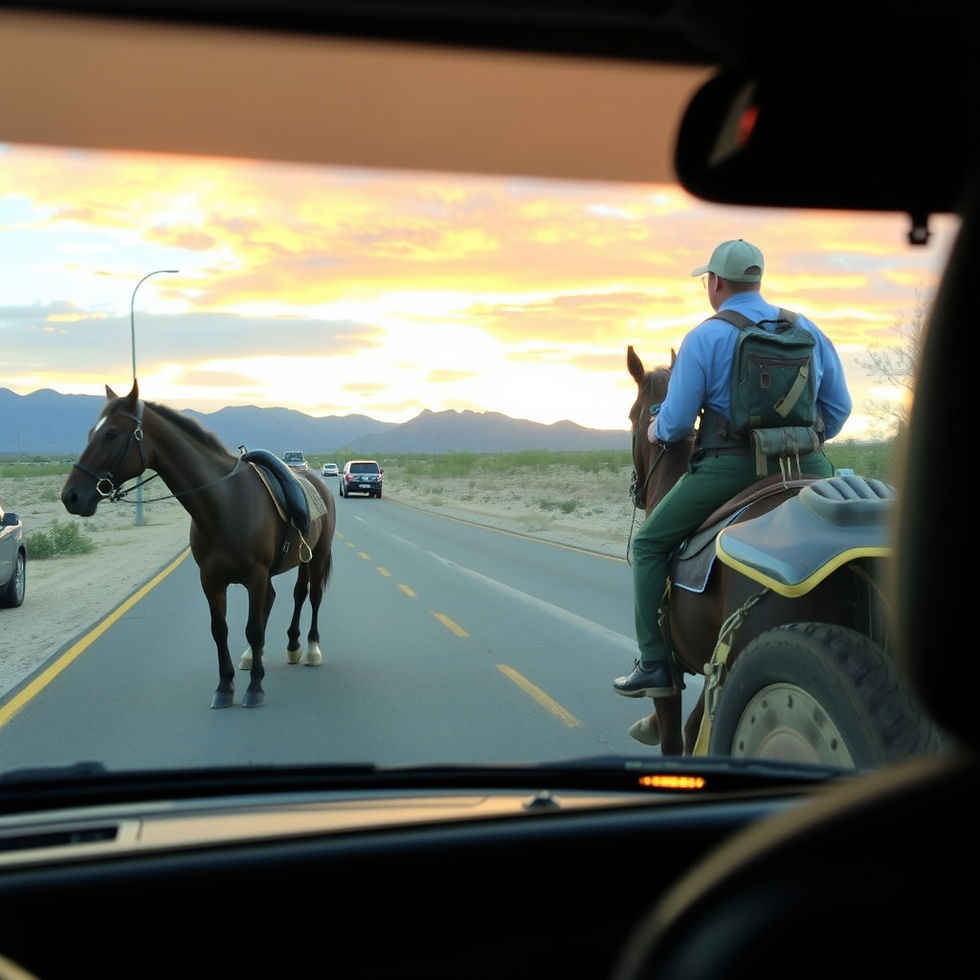
Bringing Awareness to Horses & Riders on the Roadway – A Call for Change On April 28th, 2023, my friend Ellen and I embarked on a trail ride adventure. The sun was shining brightly, the air was refreshingly crisp, and it marked the end of her birthday week—she had just celebrated her 79th birthday that Monday. We rode side by side, as we had so many times before. But that morning, only one of us returned to the barn. Tragically, Ellen's life was taken in a preventable accident. Since that day, I've heard far too many similar stories—riders injured, hospitalized, or killed because a motorist didn't know or didn't care to slow down, give space, or respect the presence of a horse on the road.

These aren't freak accidents. They're the direct results of ignorance, inattention, and inadequate laws that fail to protect equestrians. No matter how well-trained a horse may be, no matter how experienced a rider is, safety cannot be guaranteed when drivers refuse to respect road spaces. Horses aren't machines. They can't be powered down or controlled with the turn of a key. They're living, breathing animals—prey animals whose instinct is to flee from perceived danger. A loud engine revving, the sudden blast of an airbrake, or the roar of a motorcycle can trigger a reaction that even the best rider cannot always stop.
We, as equestrians, do everything in our power to prepare our horses for the unexpected, but no training can fully protect us when a driver speeds past at 60 miles per hour without a second thought. Riders can take precautions. We can wear helmets, invest in safety gear, and train relentlessly. But when a moving vehicle collides with a 1,200-pound horse, no helmet in the world will save a rider's life. A car clipping or hitting a horse is a deadly combination—not just for the rider, but for the driver as well.

The statistics are shocking. In the United States, the Centers for Disease Control and Prevention (CDC) reports that approximately 12,000 horse-related injuries occur each year, with a significant portion resulting from interactions with motor vehicles. In the United Kingdom, a study analyzing 4,107 horse-related road incidents reported to the British Horse Society between 2010 and 2020 found that drivers passed too closely in 84.2% of incidents, while road rage and speeding were reported in 40.3% and 40.1% of incidents, respectively.

These behaviors significantly increase the risk of collisions and fatalities. Northern citizens take extreme caution when it comes to open-range livestock or wildlife. A collision with an elk, a moose, or a cow is something no driver wants to risk. These are the kinds of accidents that keep families off the roads at night because they understand that striking an animal of that size is often fatal. So I ask you—why do so many people assume that hitting a horse, an animal that weighs the same, reacts the same, and moves the same, would have a less devastating outcome?

We see reinforced pedestrian crossings, bus pickup zones, caution signs, and reduced speed limits in school zones, yet when it comes to equestrians, we're expected to fend for ourselves. We're expected to take all the responsibility for our safety, while drivers aren't even required to acknowledge the risk they pose to us. Imagine this: You have your first child, and they fall in love with horses. You save every extra dollar to buy them the right horse, invest in extensive training, and enroll them in riding lessons. You teach them responsibility, caution, and safety.

Every day, you remind them, "If you see a car coming, stop, move to a safe place, and let your horse watch it pass." You drill this into them for months until, finally, after endless preparation, they ask you if they can ride down the road to their best friend's house. You hesitate, but they have worked so hard, and you know their horse is solid. You tell yourself they are ready. So you hug them, tell them to be safe, and watch them ride out of the driveway. An hour later, there's a knock at your door. A police officer stands before you, his face somber. He tells you that while your child was living out their equestrian dream, a distracted driver flew past them at 60 miles per hour, only inches away.

The horse, by no fault of his own, instinctively jumped to protect himself and the child. But in the chaos, your child lost their balance. Their foot became caught in the stirrup, and the horse panicked. Terrified, it ran—dragging your child for a mile, upside down, their body scraping against pavement, rocks, and fences. By the time the horse was caught, the damage was done. The injuries were irreversible. This is not a horror story. This is reality. This is what happens when drivers refuse to slow down. This is what happens when laws fail to protect those who share the road. Ellen should still be here.

So should the countless others who have lost their lives due to careless driving. How many more have to suffer before something changes? How many more families have to grieve before drivers are held accountable?

This is not about riders taking over the roads. This is about life and death. It's about recognizing that horseback riders deserve the same consideration, the same caution, and the same respect as any other vulnerable traveler. We cannot wait for another tragedy. The time for change is now.


Comments


bottom of page